Minimum Order Quantities (Moqs): How To Negotiate Without Overstocking
MOQs create rot. The moment you accept a minimum order quantity (MOQ) that’s built for a factory’s machine rhythm rather than your sell-through, you quietly agree to finance their risk with your cash, your warehouse, and your markdowns—and you’ll still get blamed later when “demand softened.” Why would you do that?
Let’s define the thing cleanly, because vendors love ambiguity: MOQ is the smallest batch a supplier will produce per SKU, per color, per size, per material lot, sometimes per carton artwork, and they’ll hide those “per” words until you’ve approved a sample.
And yes, there’s a reason they do it. But it’s not always the reason they say.
Table of Contents
The hard truth about why MOQs are high
A factory will tell you “raw material minimums” and “setup costs.” Sometimes true. Often incomplete.
Here’s what’s usually happening behind the curtain:
- They’re protecting utilization. If a sewing line or net-knotting machine runs best in 8-hour blocks, your small run creates idle time they can’t sell twice.
- They’re protecting procurement. If they buy PA6 nylon yarn (nylon-6, ((C6H{11}NO)n)) or PET filament (polyester, ((C{10}H_8O_4)_n)) in big lots, your “just 200 units” turns into their leftover problem.
- They’re protecting their credit exposure. Many suppliers are effectively lending you inventory until you pay; MOQ is a way to make that lending worth it.
- They’re screening customers. High MOQ is also a filter for “serious buyers,” which is code for “buyers who won’t negotiate like sharks.”
Now the buyer-side data point that matters: U.S. Census reported the total business inventories-to-sales ratio at 1.39 at the end of January 2024 (vs. 1.37 in January 2023). That’s a blunt indicator of how much stock the system is carrying relative to sales. The larger the ratio, the more overstocking punishes cashflow. Manufacturing and Trade Inventories and Sales (Jan 2024) (www2.census.gov)
So when a supplier shrugs and says “MOQs are standard,” I translate: “We prefer you to hold the bag.”

Start negotiating MOQs like an adult: leverage, not pleading
I’m going to be opinionated here: asking nicely rarely reduces MOQ. Trading terms does.
1) Replace “lower MOQ” with “lower first shipment”
Factories hate small totals. They’re less allergic to smaller releases.
You propose a phased purchase orders MOQ structure:
- Commit to a total quantity across a quarter.
- Release in tranches (and tie each release to clear triggers).
Example language (buyer-friendly, supplier-palatable):
- Total commitment: 1,000 units (contractually reserved capacity)
- Release schedule: 300 now, 300 at day 45, 400 at day 90
- Same unit price (or a smaller premium) because the factory can plan the line
This is the negotiation move most importers skip because it requires you to talk like a finance person, not a shopper.
2) Redesign the SKU so the MOQ becomes rational
If your SKU is “custom” in five ways, you don’t have a MOQ problem—you have a complexity problem.
Things that blow up MOQs:
- custom dye (especially tight Pantone matching)
- private-label packaging with new print plates
- non-stock mesh size
- special hardware (buckles, hooks, corner sleeves) sourced outside their normal vendor pool
So I push buyers to standardize what doesn’t sell the product:
- Keep the netting spec standard; customize the tag and carry bag later.
- Use one colorway for the first run.
- Pick stocked materials (PA6 or PET) and avoid exotic blends until you’ve got velocity.
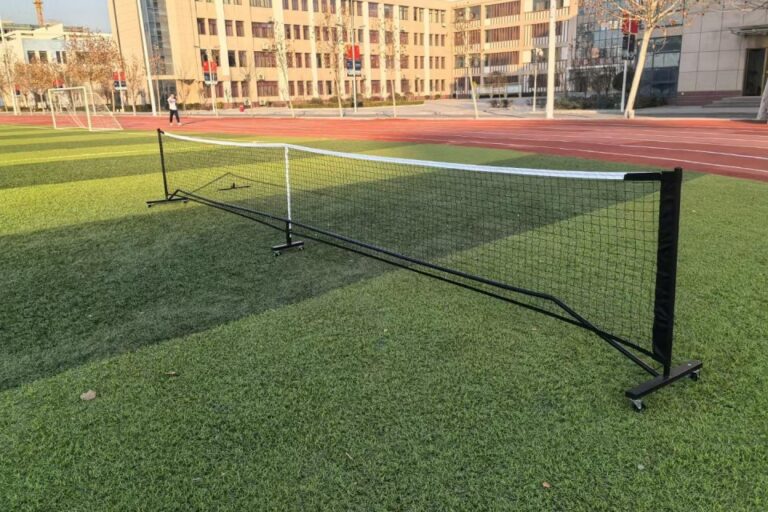
If you’re sourcing sports equipment, this is painfully relevant. A “simple” custom set can quietly become three separate MOQs: net body, frame tubes, and packaging. If you want a reality check, compare a standard category like portable pickleball net systems to a more complex build like a professional golf hitting cage net for indoor/outdoor use—the bill of materials complexity is the MOQ story.
3) Use the MOQ vs unit price tradeoff mathematically, not emotionally
Short sentence. But the math bites.
Here’s a typical conversation in numbers:
- Supplier quote at 1,000 units: $9.80/unit
- Supplier quote at 300 units: $11.40/unit (premium: $1.60)
That $1.60 feels like pain until you price the alternative:
- You overbuy 700 units “because MOQ,” and your carrying costs hit you for months.
- Add storage, capital cost, and markdown risk, and that “cheap unit price” turns expensive fast.
Real-world cautionary tale: big brands get this wrong too. Nike reported inventories of $8.9B, up 16% year-over-year as of Feb 28, 2023, and the company openly tied margin pressure to clearing inventory. NIKE, Inc. fiscal 2023 Q3 results (Nike Investors)
If Nike can get stuck, so can you.
4) Negotiate MOQs by giving the supplier what they actually want
This is where “MOQ negotiation strategies” stop being blog fluff and become a checklist:
- Offer faster payment for the first tranche (or a slightly bigger deposit) in exchange for smaller MOQ.
- Offer repeatability: “same spec, same packaging, monthly releases” is gold to production planners.
- Offer simplified QC (AQL sampling plan, clear defect definitions) so they don’t fear rework chaos.
- Offer freight flexibility: if they’re quoting EXW, you can take on FOB booking complexity and make their life easier.
And yes, you should confirm their willingness to support phased releases operationally—some can’t. If you’re evaluating a supplier, “can you actually ship partials cleanly without mixing cartons?” is as important as “can you reduce minimum order quantity.”
If you want to sanity-check a factory’s operational maturity, I’d look at transparency signals like a factory tour and whether they publish clear services for custom orders and logistics. Not because marketing equals truth, but because consistent documentation usually correlates with fewer nasty surprises.
5) Put MOQs inside a contract that punishes excuses, not you
This is where I get blunt: a phased plan without contract hooks is just a “nice email thread.”
Minimum terms I’d fight for:
- Incoterms spelled out (EXW/FOB/CIF/DDP) and who pays what.
- Lead time windows with penalties or remedies.
- Spec lock date (after which changes are paid change orders).
- Reorder pricing formula (so MOQ reductions don’t become a future price ambush).
- QA acceptance criteria tied to what happens to rejects (repair/replace/credit).
Want a supplier to take you seriously? Stop negotiating like the purchase order is the contract. It isn’t.

A field guide to MOQ levers (and what they cost you)
| Negotiation lever | Typical MOQ impact | Typical unit price impact | Inventory risk impact | When I’d use it |
|---|---|---|---|---|
| Phased releases (same total commitment) | High | Low to Medium | High reduction | When demand is uncertain but you can commit over time |
| Standardize materials/colors | Medium to High | Low | Medium reduction | When “custom” is bloating hidden sub-MOQs |
| Pay a small-run premium | Medium | Medium to High | High reduction | When cash is tighter than gross margin |
| Combine SKUs into one run (shared materials) | Medium | Low | Medium reduction | When multiple SKUs share netting/frames/packaging |
| Agree to reorder window (e.g., 60–90 days) | Medium | Low | Medium reduction | When supplier wants predictability more than volume today |
| Consignment / vendor-held stock (rare) | Very High | Medium to High | Very high reduction | When supplier is sophisticated and you have leverage |
If your product is a multi-component build (frames + netting + bag), you’ll feel this immediately. A complex SKU like an adjustable multi-sport net with rolling base and casters has more MOQ pressure points than a simple net-only item, because “minimums” attach to sub-suppliers too.
FAQs (built for skeptical buyers)
What is minimum order quantity (MOQ)?
A minimum order quantity (MOQ) is the smallest batch size a supplier will accept for a purchase order, usually set to protect machine setup time, raw-material buying minimums, labor efficiency, and cashflow predictability, even when that forces the buyer to hold more inventory than demand justifies. In practice, ask “MOQ per what?”—per SKU, per color, per material lot, and per packaging are common traps.
How do I negotiate MOQ with suppliers without getting ripped on unit price?
MOQ negotiation is the process of trading something the factory values—price, lead time, material substitution, packaging simplification, payment timing, or repeat-business certainty—in exchange for a smaller first run, so you cut inventory exposure while keeping the supplier’s margin and production plan intact. Your best lever is usually commitment + phased releases, not begging for “flexibility.”
What is a phased purchase order, and why does it work for MOQs?
A phased purchase order is a contract structure where you commit to a total quantity but split it into scheduled releases (e.g., 300 units now, 300 in 45 days, 400 in 90 days), so the supplier can plan production while you pay and receive inventory in smaller, demand-matched waves. It works because it protects utilization while moving inventory risk back off your balance sheet.
How do custom materials and branding change supplier MOQ flexibility?
Supplier MOQ flexibility is the practical room to move below the posted minimum without breaking the factory’s economics, and it typically depends on whether your order uses stocked materials (like PA6 nylon netting), standard colors, and existing tooling instead of custom molds, special dyes, or private-label packaging runs. If you want low MOQ, de-customize the first run and earn customization later.
What does “MOQ vs unit price tradeoff” actually mean in real terms?
The MOQ vs unit price tradeoff is the predictable price increase you pay when you ask a supplier to run a smaller batch, because fixed costs (setup, QC, packaging line changeover) get spread over fewer units, so you need to compare that premium to the carrying cost and markdown risk of excess stock. A slightly higher unit price is often cheaper than months of dead inventory.

Conclusion
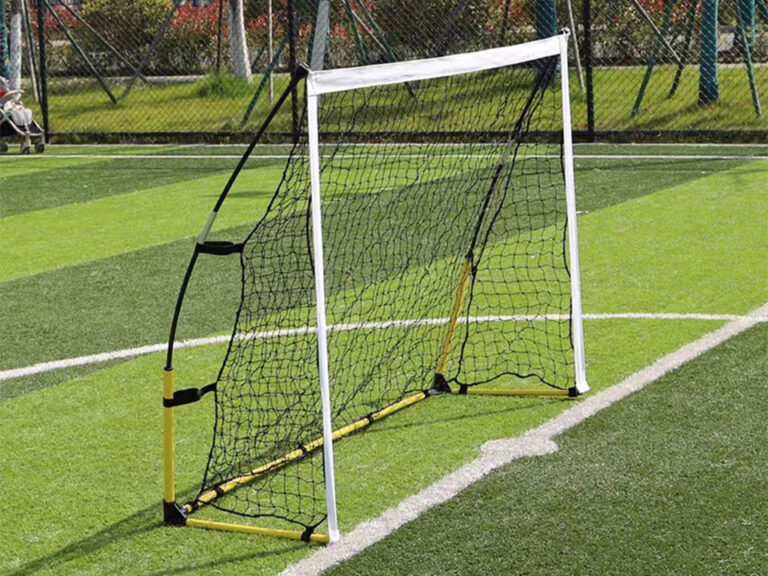
Want lower MOQs without playing roulette with quality and lead times? Start with a phased order plan, lock your specs, and then pressure-test supplier operations—documentation, production flow, and their ability to ship partials cleanly. If you’re sourcing sports nets and goals, you can reach out via the contact page and ask directly for MOQ options, phased purchase order support, and which SKUs they can run from stocked materials first.