Premium Netting Materials: Is Dyneema Or Kevlar Worth The Cost?
I’ve watched buyers light money on fire with “premium” fiber because the quote looked scientific, the breaking strength number was huge, and the vendor tossed in a brand name like it’s a magic spell—then the net died at the hem, the grommet line, or a single nasty chafe point the installer didn’t sleeve. It happens. Often.
But let’s get specific, because “Dyneema vs Kevlar” isn’t a barstool argument—it’s a failure-mode argument, and if you can’t name the failure mode, you’re not choosing materials, you’re guessing with a credit card.
So here’s my blunt take: Dyneema (UHMWPE/HMWPE) is a tension monster when weight matters and heat doesn’t; Kevlar (para-aramid, PPTA) earns its keep when heat and cut risk matter and you can actually keep UV off it. The awkward punchline? For a lot of sports setups, nylon still wins because nets don’t die in a lab test—they die at the ugly little stress risers.
Table of Contents
What “premium” buys you (and what it doesn’t)
Ever seen a net fail in a perfectly straight line along a cheap edge binding? Yeah. That’s not “fiber weakness.” That’s bad finishing.
And this is where outsiders miss the plot: nets are a grid of joints, not a single strand. The action happens at the intersections—knots, raschel joints, stitched selvage, lacing points, where your cable rubs the mesh, where a hook or bungee chews one spot like a dog with a bone.
Here’s the ugly truth: you can buy expensive yarn and still get a net that ages like milk if you ignore:
- mesh geometry that funnels load into one row (tear propagation, the “zipper” failure)
- edge treatment that saws itself apart under vibration
- over-tensioned installs (hello creep, hello fatigue)
- UV inhibitor packages that exist on paper but not in real life
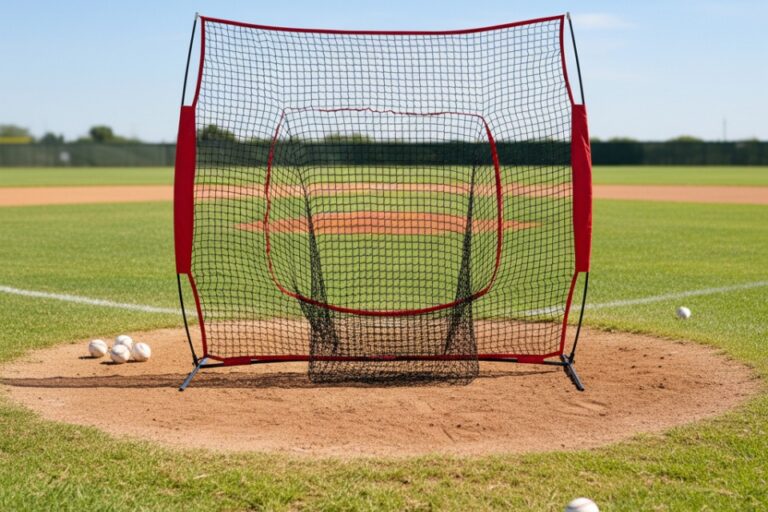
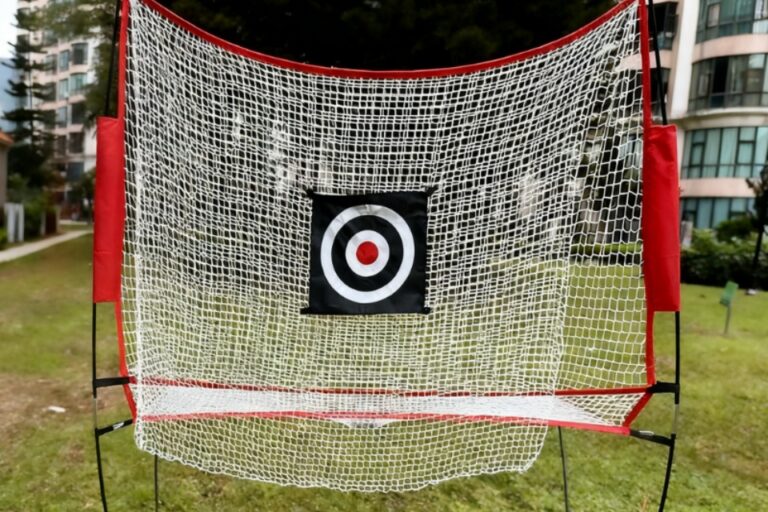
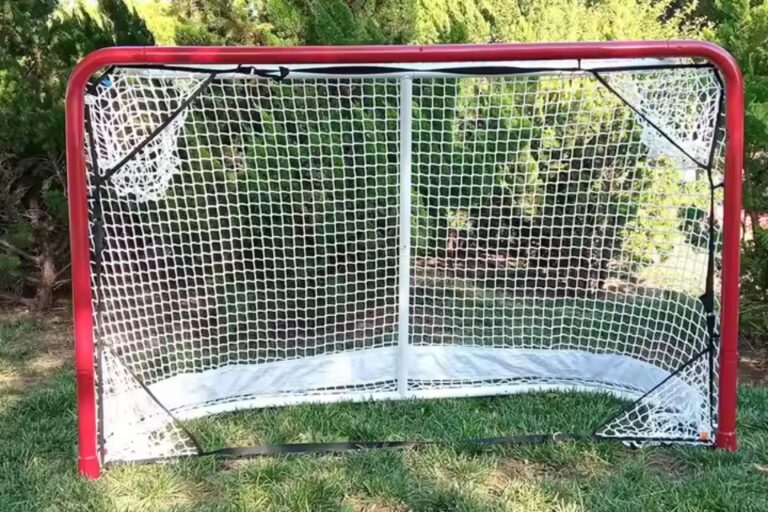
If you’re looking at baseball netting systems or golf cage net setups, don’t let anyone sell you fiber before they can explain the border, the attachment method, and the abrasion plan. That’s where the bodies are buried.
Dyneema netting (UHMWPE): scary strong, annoyingly fussy
I’ll say it plainly: UHMWPE is brilliant at pulling loads. The chain structure lets you draw the polymer into a fiber that delivers absurd strength-to-weight. Great. But nets don’t just “pull.” They live through micro-motions, flapping, grit, and constant tension you didn’t even mean to apply.
And yes—creep. The slow, quiet stretch that doesn’t ask permission.
A 2024 Macromolecules paper isn’t about backyard sports, but it’s directly relevant: UHMWPE fibers show up in ocean mooring and marine fisheries, and the researchers are explicitly chasing creep performance because constant-load environments punish polyethylene in slow motion. (pubs.acs.org)
Here’s where Dyneema netting (UHMWPE netting material, HMWPE netting) actually makes sense:
- long spans where weight drives your whole bill of materials (lighter net → lighter cable → smaller anchors)
- high-load barrier netting where tensile capacity is the design constraint
- wet environments where water uptake and handling consistency matter
Now the part vendors mumble: Dyneema netting can lose on the boring stuff:
- heat (polyethylene doesn’t negotiate with temperature)
- creep under constant preload (especially if the net is strung like a guitar)
- abrasive “hot spots” unless you build in chafe guards, sleeves, and sane attachment
Three words: design beats fiber.
Kevlar netting (para-aramid): heat/cut toughness, plus a UV hangover
Kevlar has a different vibe. It’s built for heat resilience and cut resistance, and when you genuinely have a cut hazard—sharp edges, abrasive contact, nasty friction—aramid starts looking less like a luxury and more like a tool.
Yet… sunlight. Sunlight is a tax collector.
If you leave aramid exposed outdoors without shielding, you’re basically buying performance you can’t keep. Covers, coatings, sleeves, indoor storage between use—pick your poison. If you won’t do those things, don’t buy Kevlar and pretend you’re “future-proof.”
So, is Kevlar netting “better”? Sometimes. But “better” for what—heat, cuts, and predictable stiffness? Or “better” for a sports field sitting in open sun for years? Those are not the same question.
Dyneema vs nylon netting (why nylon keeps winning when nobody wants to admit it)
Nylon is not sexy. Nylon is not a brand flex. Nylon is what actually survives a lot of real impacts.
Sports nets get punched, not gently loaded. Balls hammer the mesh, frames vibrate, stakes shift, and the net spends its life dealing with impulse loads and abrasion cycles. In that world, nylon’s toughness, knot behavior, and repairability matter more than “ultimate tensile strength.”
I frankly believe this is where buyers get played: they pay 2–3x for premium fiber, then the net fails at the same old culprits—edge wear, hardware lines, attachment points—because nobody upgraded the construction.
If you want a concrete example, compare a pragmatic system like durable nylon golf barrier net with hooks and bungees to any premium-fiber concept that ignores mounting and shock handling. The nylon setup often wins because the system isn’t pretending.
The “price of failure” test (where the math flips hard)
Quick story (and it’s not cute). A cheap tear in the wrong place isn’t “a tear.” It’s an incident.
Aquaculture is the cleanest illustration because the consequences are public, measurable, and ugly. Norway’s own reporting makes it plain: the Norwegian Institute of Marine Research notes that 8,400 farmed salmon escaped in May 2024 from a farm associated with BKD outbreaks and warns escapes can raise infection pressure on wild fish. (hi.no)
And if you want the scale of what “small percentage” really means, the Norwegian Veterinary Institute’s Fish Health Report 2023 states 62.8 million salmon died during the sea phase in 2023, plus large hatchery losses. It’s industrial biology—small failure rates become massive numbers fast. (vetinst.no)
That’s the moment premium fibers stop looking like a fancy upgrade and start looking like risk control. Different game. Different stakes. (No, I’m not being poetic—this is literally how budgets move.)
Legal pressure: sometimes you don’t get to “choose” netting
Yet another angle buyers ignore: liability doesn’t care about your spreadsheet.
New York’s legislature has proposed requiring safety netting on new and renovated bridges to prevent falling objects. Even when it’s “just a bill,” it shows the direction of travel: netting is being treated as safety equipment, which means specs and documentation suddenly matter a lot more than vibes. (nysenate.gov)
If people can get hurt, “best netting material for high load” becomes a defensibility question. What did you specify? Why? What failure mode did you design against? That’s what gets interrogated.
Where I’d start if you’re actually buying netting (not arguing online)
If your application is sports-focused, start with the category that matches how the net is abused in real life, then work backward into materials and construction:
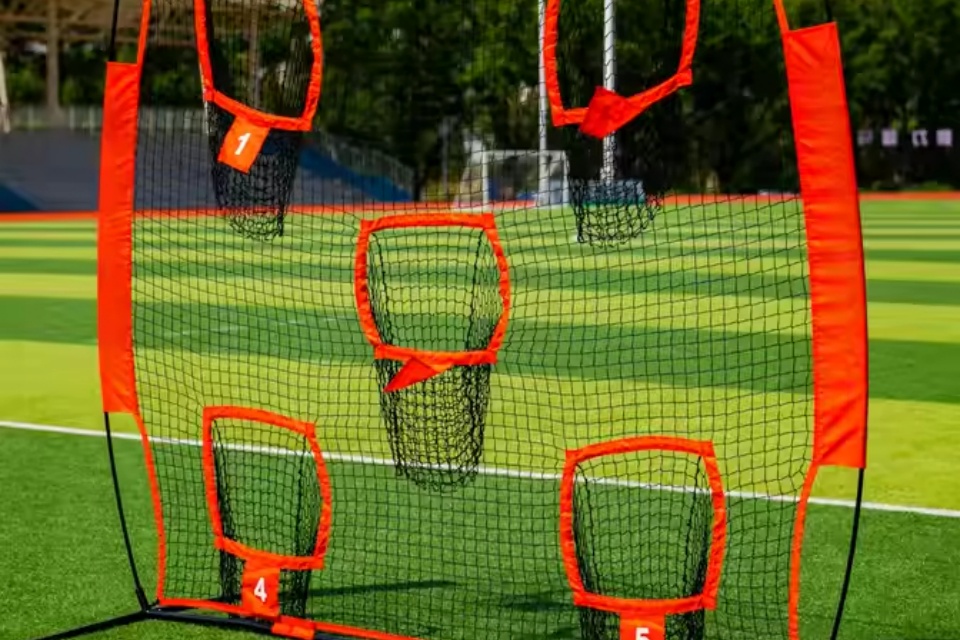
- big impact + repeated hits: rebounder nets
- long outdoor exposure + wind + UV: outdoor netting installs
- mixed training setups where mounting changes daily: multi-sport net systems
Dyneema vs Kevlar is the headline. But the install details are the plot twist.
Comparison table: what you’re really trading off
| Material | What it’s best at | What it’s bad at | Typical “worth it” scenario |
|---|---|---|---|
| Dyneema (UHMWPE/HMWPE) | Very high strength-to-weight, low water uptake, efficient long spans | Heat sensitivity, creep under constant load, needs abrasion/UV-smart construction | Long-span barrier nets, weight-limited structures, wet/marine uses where hardware savings matter |
| Kevlar (para-aramid, PPTA) | Heat resistance, cut resistance, stable under higher temps | UV exposure sensitivity if unprotected, often pricier per performance unit in outdoor sunlight | Heat-adjacent nets, cut-prone industrial zones, specialty containment where UV is controlled |
| Nylon (polyamide) | Impact handling, abrasion resilience (with good build), repairability, cost | Heavier than UHMWPE for same tensile, can absorb water | Most sports nets, training cages, general outdoor practice setups |
The simplest “worth it” filter
One question: what fails first?
If the first failure is the fiber itself—rare in sports, common in true high-load containment—premium fiber can justify itself. If the first failure is a hem that frays, a cable line that saws through mesh, or UV chalking that turns yarn brittle, premium fiber is basically expensive decoration.
It works. Usually.
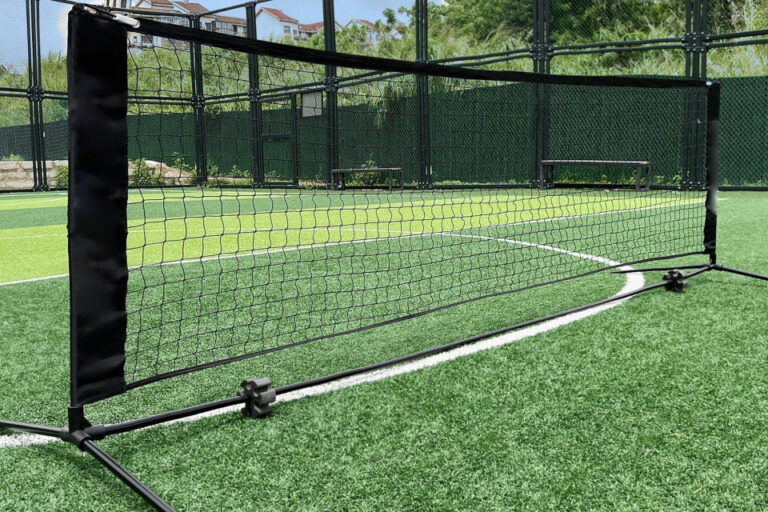
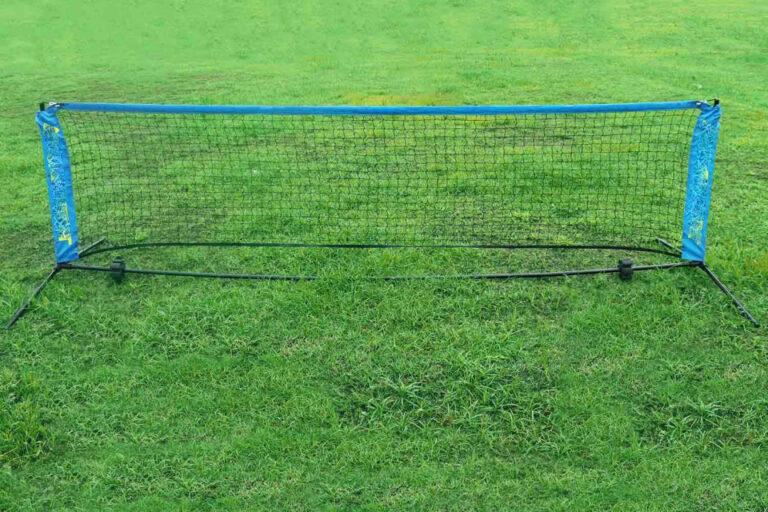
And if you’re shopping for field-ready options, the practical entry points are still categories like tennis net options and volleyball net systems, because they force you to think about tensioning, borders, and hardware—real-world stuff, not brochure stuff.
FAQs
What is Dyneema netting?
Dyneema netting is netting made from UHMWPE (ultra-high-molecular-weight polyethylene) fibers, where extremely long polyethylene chains (often described as (C₂H₄)ₙ) are drawn for high tensile efficiency, producing high strength-to-weight netting that’s typically used when weight, span length, and tension capacity matter more than heat resistance.
After that definition, here’s the part people skip: UHMWPE behaves differently under constant tension than nylon, so if your net is always preloaded (tight install, long spans), you need to think about creep, chafe sleeves, and UV-stable construction—not just “stronger fiber.”
What is Kevlar netting?
Kevlar netting is netting made from para-aramid fibers (chemically related to PPTA), designed to keep strength under heat and resist cutting better than many commodity fibers, but it often requires UV shielding or coatings outdoors because sunlight can degrade aramid performance over time if left exposed.
In shop talk: Kevlar is the “hot-zone / cut-zone” pick, not the “leave it baking outside for years” pick—unless you’re willing to protect it (covers, sleeves, storage discipline).
Is Dyneema netting worth the cost?
Dyneema netting is “worth the cost” when UHMWPE’s strength-to-weight reduces total system cost—lighter cables, smaller frames, fewer anchors—or when failure consequences justify premium containment performance, especially in long-span or wet environments where constant tensile loading dominates the design.
If your net fails at hems, grommets, or abrasion points, you’re paying for the wrong upgrade. Fix the build, then upgrade fiber.
What’s the best netting material for high load?
The best netting material for high load is the one whose weakest link matches your actual failure mode—UHMWPE/Dyneema when tensile efficiency and weight drive the system, Kevlar when heat or cut hazards dominate, and nylon when impact, abrasion cycling, and repairability decide lifespan more than lab tensile numbers.
If you can’t describe the load profile (static tension vs impact vs abrasion), any “best” answer is just a guess with nicer vocabulary.
Conclusion
If you’re choosing between Dyneema vs Kevlar for a real installation, don’t start with the catalog adjectives—start with the load case, the environment (UV, heat, salt, abrasion), and the failure cost. If you want help translating that into a spec and build, use FSportsNet Services, sanity-check the manufacturing process via the Factory Tour, and reach out through Contact with your span, mesh size, and mounting details. That’s where the right material choice becomes obvious.