How To Choose The Best Material For Outdoor Sports Netting
Why Most Buyers Get It Wrong
I’ve watched this happen more than once: somebody signs off on a roll of “commercial-grade” sports netting after a ten-minute skim of the sell sheet, likes the price, likes the black color, likes the word “heavy-duty,” and then, one brutal summer later, the mesh starts going chalky, the hang goes soft, the borders creep, and everyone suddenly acts shocked that sun and moisture were part of the job. Happens constantly.
Three months later? Complaints.
But that’s the business. Or, more accurately, that’s the lazy side of the business—the side that buys off a pretty PDF and then blames the installer, the weather, the kids, the wind, the poles, basically anything except the original material choice.
Here’s the ugly truth: most buyers still ask the wrong question. They ask, “Which is stronger, nylon or polyethylene?” I get why. It sounds technical. It sounds like procurement is doing its homework. But outdoor sports netting material doesn’t fail because of one neat tensile number on day one; it fails because UV, rain, thermal cycling, dirt loading, wind whip, bad perimeter rope, sloppy tie-offs, and slow creep gang up on it over time, and that’s a much messier story than a catalog wants to tell. That’s the real story.
Messy stuff.
Índice
The Short Answer: What Material Wins Outdoors?
So yes, I’m going to be direct: for most outdoor applications, I’d choose UV-stabilized knotless polyethylene first. Not every time, not blindly, not like some forum guy who learned two acronyms and now thinks he’s a polymer engineer—but as a baseline, for weather-resistant sports netting that lives outside and gets cooked all season, PE is usually the better bet.
Normalmente.
And that word matters. Because nylon sports netting still has a place. I’m not here to pretend it doesn’t. Inside cages? Semi-sheltered training bays? Some impact-heavy setups where that softer catch and familiar rebound feel matter? Sure. Nylon can still earn its keep. But out in the open—real sun, real rain, real neglect—it’s not my default anymore.
Why Outdoor Netting Really Fails
Weathering, UV, and Long-Term Degradation
Why? Start with weathering. NIST’s weathering research exists for a reason: polymers don’t age politely. UV, moisture, and heat keep changing them long after the invoice is paid. That’s the part cheap buyers forget. The net doesn’t need to fail on arrival. It just needs to degrade quietly enough that nobody notices until replacement season gets ugly.
And then it’s “unexpected.”
No, it wasn’t.
Why “Black Netting” Isn’t Enough
From my experience, the market loves cosmetic signals. Black mesh. Thick twine. “Outdoor grade.” Maybe a nice product render with a stadium in the background. But black doesn’t automatically mean UV-resistant netting—this is where people get played. The Open University’s polymer materials guide explains that carbon black can improve UV resistance in polyethylene, but it also notes that poor distribution can create stress concentration. So when a rep says, “It’s black, so you’re good,” what I hear is, “Please don’t ask me about the additive package.”
Ask anyway.
Nylon’s Strengths — and Its Baggage
And while we’re at it, don’t confuse a nice hand-feel with outdoor durability. That’s another trap. Nylon can feel premium. It can look premium. It can perform beautifully in the right setup. But older NIST research on polyamides is still relevant because it gets at the core issue—UV degradation is real, and water absorption changes behavior. That doesn’t mean nylon is bad. It means nylon comes with baggage. Outside, baggage costs money.
And sag.
Match the Material to the Sport
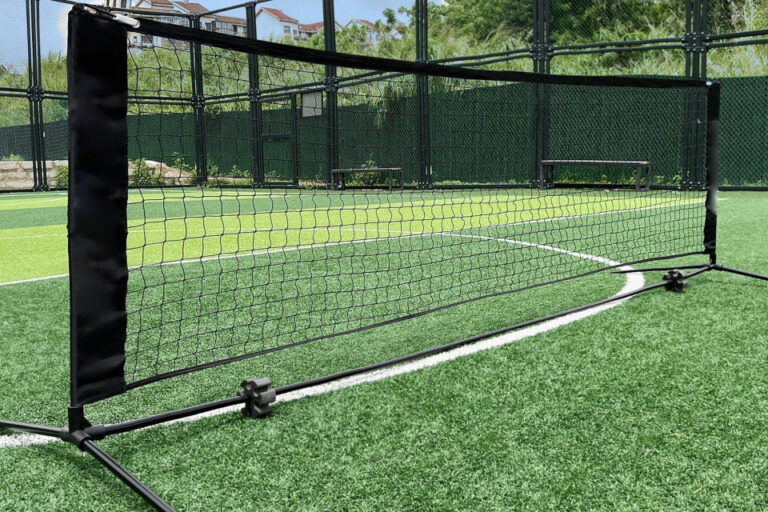
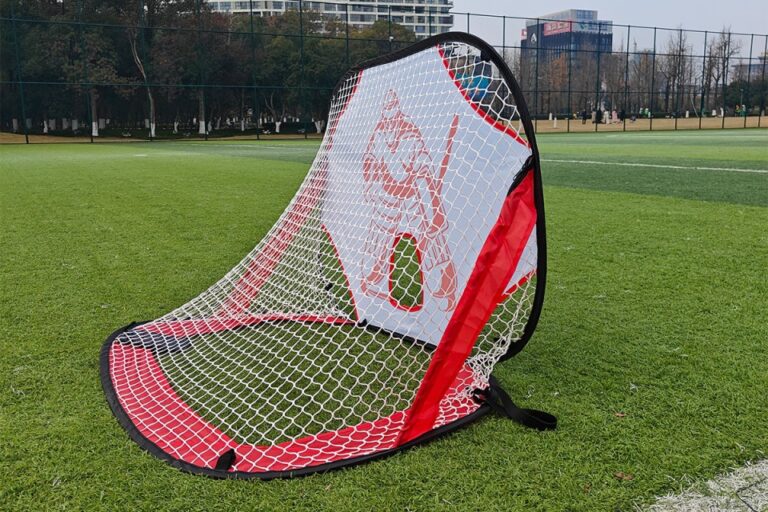
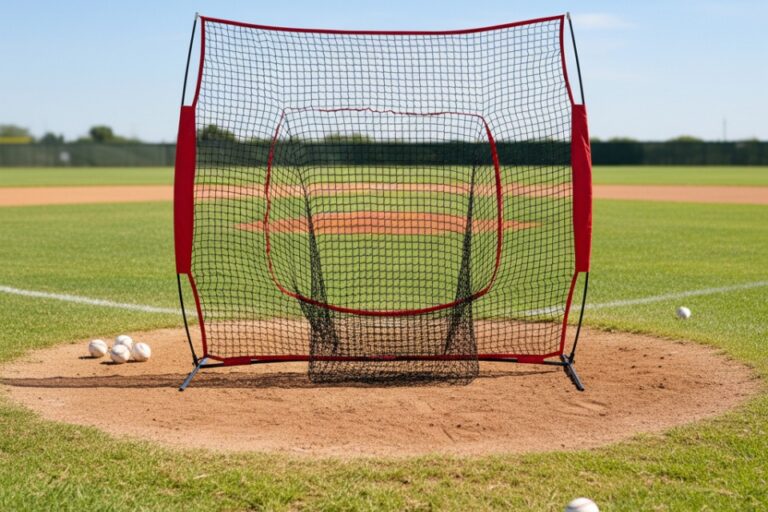
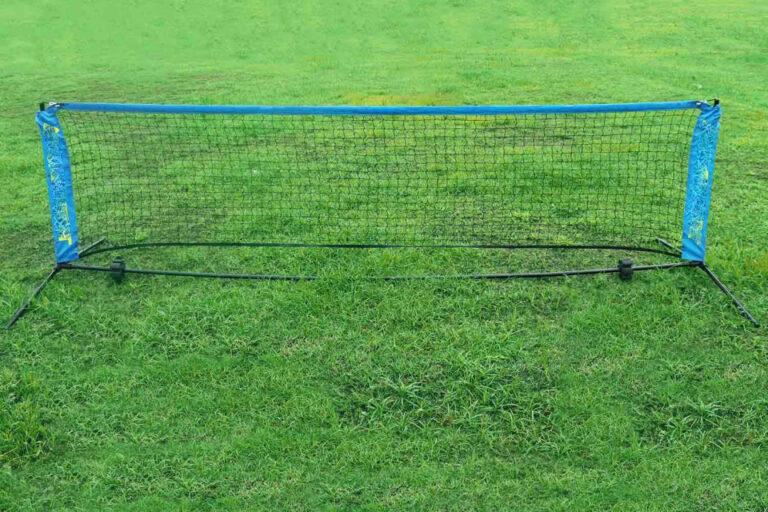
That’s why I still tell buyers to start with application, not brand hype. If you’re sourcing for a fence-line barrier, a field divider, a foul-ball containment run, or general outdoor perimeter protection, begin with actual sistemas de redes para desportos ao ar livre. Don’t grab generic mesh just because the dimension and color happen to match. If the project is baseball, go to opções de redes de basebol and spec it properly. If it’s golf, the impact profile changes fast, so look at golf netting setups. Different ball speed. Different strike pattern. Different abuse.
Different headaches.
What Installers and Standards Already Tell Us
Real-World Installer Logic
I frankly believe too many buyers treat netting like commodity cloth, and that’s where the trouble starts, because mesh behavior outdoors is tied not just to polymer family but to construction style, knot geometry, border finish, rope chemistry, hardware exposure, suspension load, and whether the install is going to see gusting wind or steady dead load. If you’ve ever seen a panel that was “strong enough” on paper but looked tired and bellied-out in under two years, you already know what I’m talking about. Specs lie by omission all the time.
And the old installers knew this. The SportsTurf / Michigan State archive is still worth reading because it gets refreshingly practical: polyethylene doesn’t absorb water like nylon does, tends to weigh less in suspension, and knotless construction can help reduce wind resistance; that same piece also flagged polyester as an option some installers liked because it stretched less over time at similar break strength. That’s the kind of shop-floor logic I trust more than slick ad copy.
Because it came from installs.
Ask for Test Data, Not Buzzwords
But then you hear the usual pushback: “Okay, but what about strength?” Fine. Ask for strength. Just don’t stop there. Ask for weathering, too. ASTM G154 matters because it deals with accelerated exposure to UV, moisture, and heat. ASTM D5034 matters because it covers breaking strength and elongation in textile fabrics. If a supplier can’t speak clearly about both, you’re probably not talking to a serious manufacturing partner—you’re talking to a box mover with better branding.
That happens a lot.
Why This Choice Matters More Now
Participation Growth Is Raising the Stakes
And now the stakes are higher. Not theoretically. Right now. According to SFIA’s 2024 State of Pickleball Report, pickleball participation jumped 51.8% from 2022 to 2023 e 223.5% over three years. Then Reuters reported in July 2024 that Pickleball World Rankings launched a global tour with $15 million in prize money. More courts. More recreational builds. More outdoor frames. More replacement cycles waiting to punish cheap buying.
It adds up.
Safety and Liability Pressure Are Growing
And safety pressure is tightening, too, which means the old “good enough” spec is aging badly. In the Nashville Sports Authority meeting minutes, First Horizon Park logged a $225,000 protective netting extension tied to league requirements before the 2025 season, while Assembly Bill A300 in New York’s 2023–2024 session pushed for a formal look at whether current protective netting standards in baseball venues are actually sufficient. That’s not background noise. That’s the direction of travel.
More coverage. More scrutiny.
How I Actually Evaluate Sports Netting Material
So when someone asks me how to choose sports netting material, I don’t start with “nylon vs PE” in some abstract vacuum. I start with failure mode. What’s the exposure? What’s the ball velocity? What’s the mesh opening? What’s the hang height? Is this backstop, cage, divider, shank net, perimeter, or overhead containment? What’s the wind map? What’s the replacement strategy? Can the panel be swapped, or do you have to redo the whole bay? That’s how grown-up specs are written.
Not with adjectives.
Other Materials Still Have a Place
And yes, there are exceptions. Nylon still makes sense in some impact-driven cage environments. Polyester deserves more credit than it gets—especially when buyers care about lower stretch over time and better shape retention. UHMWPE-class fibers like Spectra or Dyneema? Excellent material, serious performance, beautiful strength-to-diameter ratio, cleaner sightlines. But the price jumps fast, and most municipal, school, and club buyers don’t actually need to pay top-shelf fiber money for a basic outdoor barrier install.
That’s overkill.
Construction Matters Too
Another thing buyers miss: knotless versus knotted isn’t just an aesthetic choice for people who like cleaner-looking mesh. It affects wind drag, stress concentration, visibility, and how the panel behaves once it’s hung and loaded. I’ve seen people obsess over twine thickness and then completely ignore construction. That’s like shopping for tires by rubber smell.
Doesn’t help.
My buying matrix
| Material | My outside verdict | I use it when | O que normalmente corre mal |
|---|---|---|---|
| UV-stabilized PE / HDPE | Best overall default for outdoor sports netting | Backstops, barrier nets, field dividers, perimeter protection | Buyers assume all black PE is equally UV-stabilized |
| Nylon (PA6 / PA66) | Strong, useful, but not my default outside | Impact cages, practice areas, some golf or baseball applications | Water pickup, stretch, fading, weather exposure fatigue |
| Polyester | The underrated middle option | Jobs where lower stretch and shape retention matter | Often ignored because buyers only compare nylon vs PE |
| UHMWPE / Spectra / Dyneema | Premium choice, premium bill | Pro venues, high-visibility installs, elite projects | Price shock and overbuying for ordinary facilities |
What I’d Ask Before Buying
But tables make everything look cleaner than it is.
In the field, the buying checklist is uglier. I want to know the exact polymer family, the UV package, whether the supplier has retention data after weathering, what the edge finish is, what the selvedge looks like, what the border rope material is, what the hardware coating is, whether the mesh is twisted or braided, whether the panel is knotless or knotted, whether the install is cable-hung or frame-tensioned, and whether replacement means patching a panel or ripping out the whole assembly. That’s the stuff that actually changes cost-of-ownership.
Not the slogan.
Choosing for Multi-Sport Facilities
And if the project includes mixed-use courts or a flexible rec build, stop trying to force one generic mesh solution into every sport zone just because procurement wants fewer line items. That’s penny-wise, maintenance-stupid. A smarter move is to compare purpose-built sistemas de redes polidesportivas and size the material to the abuse pattern instead of pretending soccer, baseball, golf, and court dividers all beat up mesh the same way.
They don’t.
How to Vet a Supplier
Here’s my rule: if the supplier sounds smooth but vague, keep digging. Ask for the weathering data. Ask for the tensile data. Ask where the net is made. Ask to see the plant. Ask how color stability is handled batch to batch. Ask what the warranty excludes—because that part is always fun. And if you really want to separate the real operators from the brochure merchants, request a visita à fábrica or just contact the team directly. Serious manufacturers don’t panic when the questions get specific.
That’s when you learn everything.
FAQs
What is the best material for outdoor sports netting?
The best material for outdoor sports netting is usually UV-stabilized knotless polyethylene because it offers low moisture absorption, strong dimensional stability in humid weather, reduced wind resistance in many applications, and better long-term outdoor durability when the resin and additive package are actually formulated for extended UV exposure.
That’s my straight answer. PE usually gives outdoor buyers the cleanest balance of durability, maintainability, and cost control—assuming the formulation is real and not just sales fluff.
Is nylon or polyethylene better for outdoor sports netting?
Theethylene is generally better for outdoor sports netting exposed to sun and rain, while nylon is better suited to applications where impact feel, flexibility, or cage-style performance matters more than resistance to moisture pickup, stretch, and long-term outdoor weathering under full exposure conditions.
That split matters. Nylon isn’t dead. It’s just overused in jobs where weather gets the last word.
How do I know whether a net is truly UV-resistant?
A truly UV-resistant net is one supported by documented weathering performance, clear material identification, and test results showing retained physical properties after exposure to ultraviolet light, moisture, and heat, rather than a vague claim based only on color, appearance, or the phrase “outdoor grade.”
Don’t take “UV treated” at face value. Ask what was added, how it was tested, and what the retained strength looked like afterward.
Does knotless netting matter for outdoor installations?
Knotless netting matters because net construction changes wind loading, visibility, stress concentration, and dimensional behavior, which means two products made from similar polymers can perform very differently outdoors depending on how the filaments are joined and how load moves across the mesh.
It gets overlooked way too often. Material family alone doesn’t tell the whole story.
How long does outdoor sports netting last?
Outdoor sports netting lifespan is the period during which the net keeps enough strength, shape, safety, and visibility to remain fit for service, and that lifespan depends heavily on polymer choice, UV package, construction style, installation quality, climate severity, and actual maintenance practices.
I don’t give fake one-size-fits-all year counts. A windy coastal site, a shaded school yard, and a desert training facility are living completely different lives.
Conclusão
If you’re comparing options now, start with the real use case—not the marketing label. Review sistemas de redes para desportos ao ar livre, compare opções de redes de basebol, look into golf netting setups, and weigh actual sistemas de redes polidesportivas. Then push harder than most buyers do: ask for the weathering data, ask for the tensile data, and make the supplier prove the mesh can survive outside after the glossy PDF stops doing the selling.